Tuesday, July 24, 2018

50 Africa Based Educators to Follow on Twitter...via Mr Kemp

Twitter is a great tool for educators. I couldn't live without it. I am @fibeal on Twitter. So when I read Mr Kemp's post on his blogpost entitled '50 Africa Based Educators to Follow on Twitter http://bit.ly/2mFtNzF in May,  I was delighted to see my name there! Thank you Mr Kemp! He says: "I have been doing some research, connecting with my PLN and finding the best of the best Educators from every corner of the globe to feature in my series of Location Based Educators to follow." 


Are you wondering who Mr Kemp is? Craig Kemp describes himself as the "passionate Head of Educational Technology at a large International School in Singapore. I am a lifelong learner, dream creator and thought leader. I love to inspire others and find inspiration." He has a very popular blog called MrKempNZ (he is a New Zealander). 

Why I love Twitter
This got me thinking about why I love Twitter so much as a teacher. Here are my top five reasons:

1. Become part of a global community of teachers
I joined Twitter in 2009. I have got to know so many teachers around the globe through Twiiter. In fact when I attended the Google Teacher Academy in New York in 2012, we referred to each by our Twitter handles (mine is @fibeal) because we found that we already knew each other from Twitter.

2. Keep informed about using technology in the classroom
Twitter is one of the best ways to find out what is happening around the world technology-wise in classrooms. Twitter posts often lead to blog posts. And, there are some incredible teachers out there with amazing, informative blogs. Teachers love sharing with one another. I have been inspired by all the wonderful ideas that teachers pass on. ' One idea always leads to another' is what I often think to myself. Here in South Africa we use the #ZAedu hashtag for sharing ideas that might interest South African teachers.

3. Share ideas and resources

Sometimes you either create a really good lesson, or you discover someone else's excellent post and you really want to share this with your followers. Twitter is the perfect tool for sharing ideas and resources.

4. Embrace new ideas
Twitter is a form of professional development. It\s a place to learn about best teaching practices. Often one has an idea one would like to try out and then you see others are doing it and tweeting about it. I find that this gives me courage to step out and embrace change and new perspectives.
5. Enjoy Twitter chats
These are the best. I love connecting with local teachers in South Arica in a Twitter chat talking about something really relevant. In fact here in South Africa we have an exciting monthly Twitter chat on the #ZAedu, led by the innovative pair @LadyWesner and @MsMorrisTeach. It takes place on the last Wednesday of the month at 20:00. This month it will be on a chat about the changing educational landscape in ZA and ideas on how to navigate it.

50 Africa Based Educators to Follow on Twitter
So who are the 50 Africa-based educators to follow on Twitter according to Mr Kemp? Here is the list from his blog.
  1. @jcd118 (Zambia)
  2. @JeanetteViljoen (South Africa)
  3. @pandiononline (Ghana)
  4. @BrotherMENN (Ghana)
  5. @EarlGreyTeacher (South Africa)
  6. @hall_patch (Sudan)
  7. @Pam_Macmillan (South Africa)
  8. @moniquefranzsen (South Africa)
  9. @EduRonen (Ethiopia)
  10. @MacJordaN (Ghana)
  11. @ajegbers (South Africa)
  12. @TechTeachersZA (South Africa)
  13. @MichelleLissoos (South Africa)
  14. @rharwood17 (Ghana)
  15. @Luke_MacBride (Ghana)
  16. @LadyWesner (South Africa)
  17. @EdTechKevin (South Africa)
  18. @SarahHTANZ (Tanzania)
  19. @teachmrj (Ethiopia)
  20. @HartElsabeEdu (South Africa)
  21. @Omashani (South Africa)
  22. @egbal_karrar (Sudan)
  23. @BronwynWrites (South Africa)
  24. @MrZachG (Sudan)
  25. @GillianGouws (South Africa)
  26. @MsMorrisTeach (South Africa)
  27. @butterfly_class (South Africa)
  28. @mikewamaya (Kenya)
  29. @awittor (Ghana)
  30. @LynethCrighton (South Africa)
  31. @rsharwood1 (Ghana)
  32. @j_iglar (Ethiopia)
  33. @che_marnie (South Africa)
  34. @Kevin4Ed (Senegal)
  35. @MsLauraSWA (Tanzania)
  36. @phutiragophala (South Africa)
  37. @msholcombe (Liberia)
  38. @SeanHCole (South Africa)
  39. @Ebunayo (Nigeria)
  40. @kunleAdewale505 (Nigeria)
  41. @MissLFreedman (Ghana)
  42. @chezwi (South Africa)
  43. @nikkibarnard (South Africa)
  44. @abdiism (Kenya)
  45. @teblesmo (South Africa)
  46. @fibeal (South Africa)
  47. @EdtechAnt (South Africa)
  48. @KarenWalstra (South Africa)
  49. @Alister_Payne (South Africa)
  50. @irenebasson (South Africa)\
To conclude. Thank you Mr Kemp, and Twitter!

Selected as one of 10 finalists in the ISPA Super Teacher competition 2018 - yay!

received SUCH an exciting email yesterday one of the ISPA Superteacher competition organisers:


 'I am writing to confirm that the project you submitted has been selected as one of the top ten finalists in this prestigious national competition. Warmest congratulations on an outstanding achievement!

As a Finalist, you are offered an all-expenses paid trip to Capetown for the ISPA SuperTeacher Gala Dinner Awards Ceremony on Monday 22ndnof August at The Westin Hotel . The awards ceremony will take place in the context of iWeek - http://www.iweek.org.za."


What is the ISPA SuperTeacher Competition?
The 2018 ISPA SuperTeacher Competition is an annual competition sponsored by the Internet Service Providers’ Association (ISPA) and WASPA. The competition is managed by the Digital Education Institute.

This prestigious competition has a proud history going back to 2001, when ISPA launched the competition to support their Train the Teacher ICT Project. This year we will be focusing on classroom practice as well as personal teacher development. We are hoping to extend the competition to include many more teachers.

What is the aim?
The ISPA SuperTeacher Competition gives educators an opportunity to showcase their skills in using Information Communication Technologies (ICT) to improve the educational environment within their
classroom, school or community.

Who is eligible?
All educators currently teaching at schools throughout South Africa.

What will be required for entry?
Teachers will be taken through an online process of creating an ICT enhanced project for submission. Training and professional development webinars assist and motivate teachers to innovate. Internet access is therefore important.

Categories

Category 1:
ISPA SuperTeacher Award
Open to educators at Quintile 1 to 3 schools.
Previous finalists and entrants may re-enter.

Category 2:
ISPA Tech Teacher Award
Open to educators at Quintile 4 & 5 schools.
Previous finalists and entrants may re-enter.
Project focus areas for Categories 1 and 2 (Choose 1 of the following 3)

A. Curriculum integration and classroom management:
The project demonstrates the creative and efficient use of ICT to enhance teaching and learning in the 21st century.

B. Effective school leadership and management
The project demonstrates the innovative use of ICT skills to enhance overall productivity, educator or learner motivation, administration or extra-curricular activities in the school.

C. The school in the community
The project demonstrates the appropriate and effective use of ICTs to strengthen the relationship between the school, its parent body or the community it serves.

Category 3:
Mobile Tech Teacher Award
Open to all teachers as well as previous finalists and winners of previous years.

So, I am beyond excitement and very grateful for this opportunity.


Saturday, July 21, 2018

Gamifying the classroom #1: What does it mean to gamify the classroom?

I am very interested in adding some gamification to my lessons at school.

What is meant by 'Gamification'?

As an educator I'm very interested in how to in ways of making the curriculum relevant meaning for an interesting. every teacher would like their learners to be engaged while they are learning under them. for me gamification is the key. educators have been talking about this globally for a while now.

“In gamification, the student does not play an entire game from start to finish; rather they participate in activities that include elements from games such as earning points, overcoming a challenge or receiving badges for accomplishing tasks. The idea is to integrate game-based elements more commonly seen in video.”

-Karl Kapp http://bit.ly/2vpsFo3


Why do I want to add gamification?

For a long time now I've been interested in the concept of gamifying the classroom.  I think we all know that our learners love video games, computer games and other types of games and so I have been researching what it is that makes a game so captivating. How can I use these principles in my lessons?

The things that interest me about gamification

  • The player uses facts and information as tools to solve problems in context,
  • Useful feedback is given back regularly during the game
  • Information Is presented in levels. When a level is not reached the player tries again and doesn’t see this as failure. The learner aims for mastery.
  • Collaboration is usually necessary for success
  • Badges are given to show mastery.
  • Terminology such as Quests, Challenges, Missions etc are used.
  • What is gamification?
  • Games can be a very strong motivator for students when the same game elements are applied in an educational context. Thus, some educators have adopted the concept of Gamification, where the structure of gaming is applied to a non-game framework.
The following video on YouTube, called 'Gamification' explains the concept of gamification.
https://www.youtube.com/watch?v=nYnbapB5Yl8


How can I go about adding gamification to my learning experiences?

I thought that I would like to make a start a simple start by letting my grade 6 learners create e-portfolios in their blogs using the concept of gamification.

Ideas to Gamify Your Classroom

Here is a great list of ideas:
  • Foster collaboration  Present the classroom syllabus as a form of a game and have students create classroom goals and rules with you.
  • Provide instant feedback - In a game setting, feedback is essential for students to know how they are doing in the game. If a student makes a choice in a game, it is usually known immediately if that choice was the right one.
  • Make progress visible - Progress bars and levels in games allow students to set goals for themselves and celebrate success once achieving them.
  • Create challenges instead of homework - In games, students are constantly required to meet challenges, such as identify patterns or break codes. The same element can be applied to homework and projects in a fun, yet challenging way.
  • Give students choice and a voice - Games often give students various choices. Instead of simply issuing a test, you can allow student to take different paths to demonstrate their understanding of the material.
  • Offer badges and rewards - Badges or other rewards are a good way of recognizing student achievement and for giving students an incentive to continue reaching their goals.
  • Allow for second chances - When a challenge is failed in a game, students are able to learn from their mistakes and try again


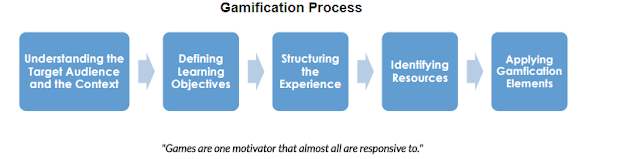
  • Target audience: My class, improve, engage, motivate, share,
  • Defining objectives: Create -e-portoflios using blogs, learning about disigtal safety online, use gaming terminology
  • Structuring the experience:
  • Start the term with challenges. Link each one to a badge. Prepare all the lessons. Link them to Hyperdocs.
  • Apply gamification elements. Badging, challenges, instant feedback on their blogs and in the classroom as I walk around, Here is a breat post on 'How to make a badge using Google Drawing' from Alice Keeler: https://alicekeeler.com/2015/01/10/create-a-badge-with-google-drawing/

So, I am keen to get started in my classroom. 

Further reading

1. Gamify your classroom: 
https://sites.google.com/site/dbennerorg/webinars/gamify-your-classroom